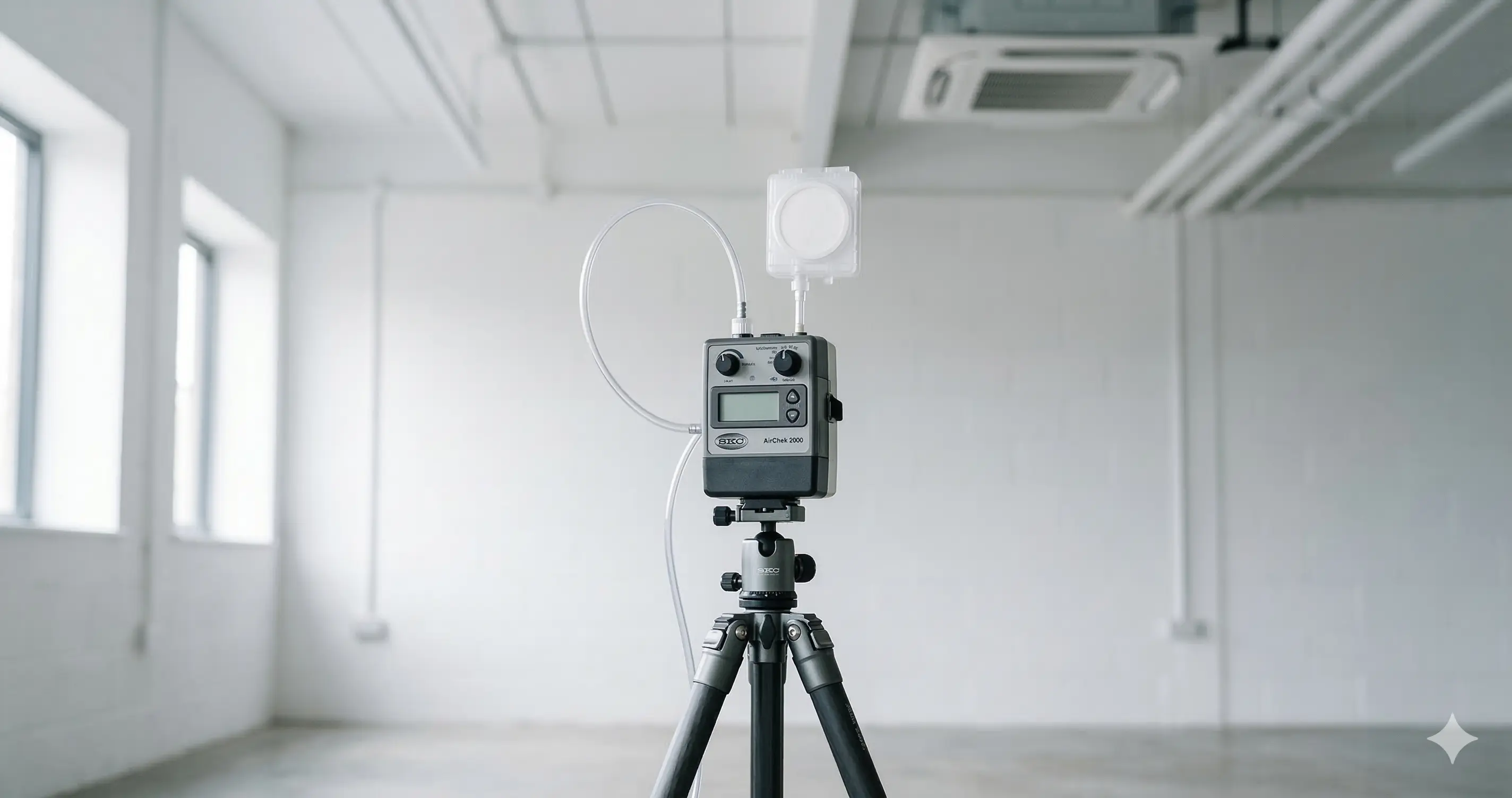
Asbestos air testing measures the concentration of asbestos fibres in the air. It is a specialised procedure distinct from an asbestos survey — and understanding when you need it can save you time, money, and serious legal risk.
What Is Asbestos Air Testing?
Asbestos air testing — also called fibre counting or airborne fibre monitoring — involves drawing air through a filter membrane and counting the number of asbestos fibres under a microscope. The results are expressed in fibres per millilitre of air (f/ml) or fibres per cubic centimetre (f/cc).
Air testing must be carried out by a UKAS-accredited body using equipment calibrated to recognised standards. The analysis is conducted in an accredited laboratory and the results are compared against the clearance indicator set by the HSE.
Types of Asbestos Air Testing
1. Clearance Air Testing
This is the most common form. After asbestos has been removed by a licensed contractor, the removal area must pass a clearance air test before it can be reoccupied. A UKAS-accredited analyst carries out a four-stage clearance procedure that includes a visual inspection, air testing, and issuing a certificate of reoccupation.
Clearance air testing after licensed asbestos removal work is a legal requirement under CAR 2012. The analyst must be independent of the removal contractor.
2. Background Air Monitoring
Background monitoring establishes the normal fibre concentration in a building before any works begin. This baseline is used to determine whether works have released additional fibres into the air.
3. Personal Air Monitoring
Used during asbestos removal work to measure the exposure of individual workers. This type of monitoring is typically commissioned by the removal contractor to comply with their legal duty under Control of Asbestos Regulations and COSHH.
4. Reassurance Air Testing
Carried out to reassure occupants or building owners that asbestos fibres are not present in the air at harmful levels — for example, following accidental disturbance of asbestos, or in buildings known to contain ACMs. Results below the clearance indicator provide evidence that the building is safe to occupy.
Find a UKAS-Accredited Surveyor
Search our directory of verified asbestos inspection bodies across the UK.
Search Surveyors →When Do You Need Air Testing?
| Situation | Air Test Required? |
|---|---|
| After licensed asbestos removal | Yes — legally required |
| After non-licensed asbestos removal | Recommended best practice |
| Before building reoccupation after works | Yes, if ACMs were in the area |
| Accidental asbestos disturbance | Yes — reassurance testing |
| Routine monitoring of ACMs in good condition | Not usually required |
| Pre-works baseline monitoring | Recommended for notifiable works |
What Is the Four-Stage Clearance Procedure?
After licensed asbestos removal, re-entry to the enclosure (the containment area) follows a strict four-stage process:
- Stage 1: Visual inspection by the analyst to confirm all visible asbestos has been removed and the area is visually clean
- Stage 2: A thorough visual inspection after the enclosure has been left to settle (typically a minimum of 10 minutes)
- Stage 3: Air samples taken and submitted for laboratory analysis
- Stage 4: Certificate of reoccupation issued if results are below the clearance indicator (0.01 f/ml)
How Much Does Asbestos Air Testing Cost?
Clearance air testing typically costs between £250 and £600 for a standard domestic or small commercial removal. Larger enclosures with multiple sampling points will cost more. Personal air monitoring and background monitoring are typically priced per sample, with day rates for on-site attendance applying.
Air testing must be quoted and carried out by a UKAS-accredited organisation. Many asbestos survey companies offer air testing alongside their survey services.